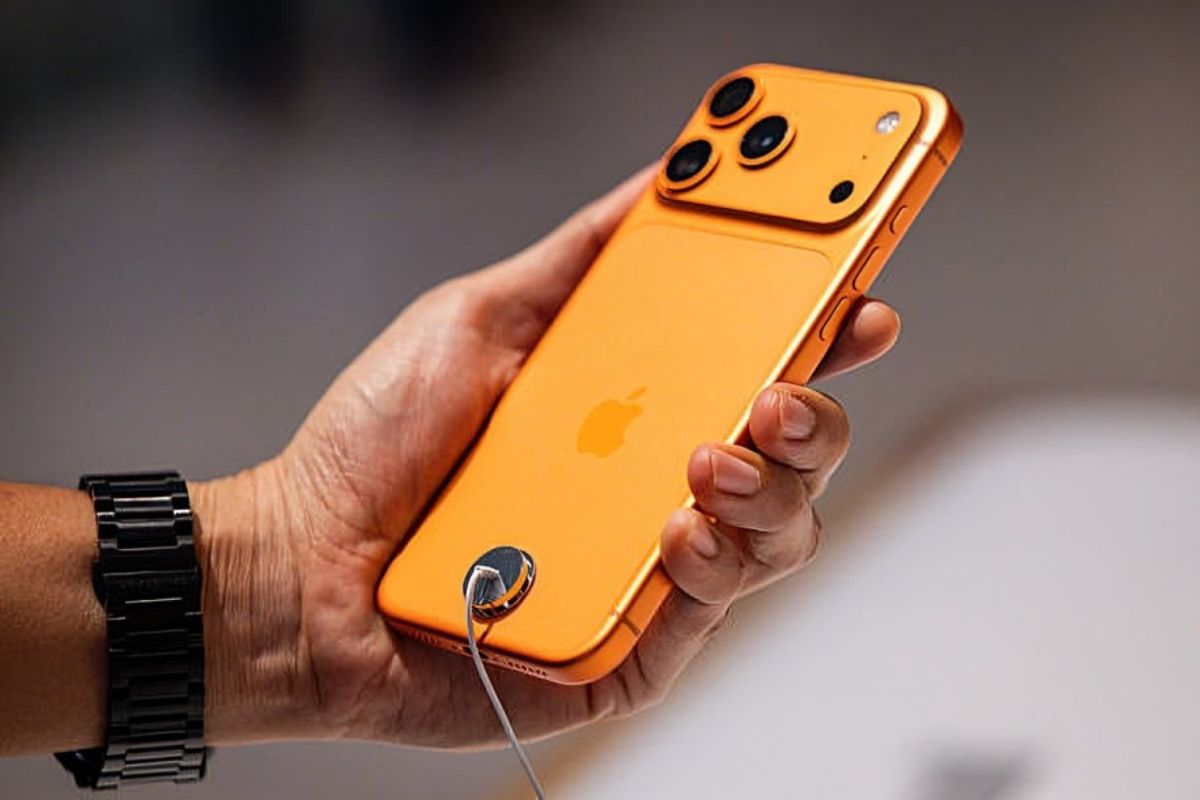
Design & Materials: Leaks suggest Apple is drastically overhauling the iPhone 17 Pro line. Both Pro models are expected to use a unibody 7000-series aluminum frame instead of the titanium used on the iPhone 15/16 Pro.
Early renders and regulatory filings describe a new “camera plateau” – a wide, horizontal bump spanning most of the back – housing the triple cameras on the left and flash/LiDAR on the right. This plateau and aluminum frame give the backs a two-tone look: most of the back is aluminum, except a cutout around the cameras made of tougher “Ceramic Shield” glass. Apple’s official press images also show the Pro models in three new finishes (Deep Blue, Cosmic Orange, and Silver), as seen below.
Both phones retain IP68 dust/water resistance, and Apple has reportedly added an improved Ceramic Shield 2 glass on front (with an anti-reflective coating) for up to 3× better scratch resistance. The new aluminum chassis improves heat dissipation (supporting a built-in vapor chamber), but it also makes the phones heavier than last year (about 206 g for the Pro and 233 g for the Pro Max).
Apple is carrying over the Dynamic Island notch design on the front, and both models keep the customizable “Action” button on the left edge. Notably, the iPhone 17 Pro adds a new Camera Control button on the right side (in addition to the power button) – a sapphire-covered button designed to mimic a DSLR shutter, with haptic feedback and swipe gestures for zoom/exposure adjustment.
This lets users open the Camera app with a single press or use half-press gestures to lock focus or zoom. (The standard Alert-Silent switch remains replaced by the Action button.) In summary, the iPhone 17 Pro series looks to return to an almost-all-aluminum build – rumored in January and confirmed by Apple’s September 2025 announcement – with a wide camera plateau to enable improved components and cooling.
Display & Durability
Both models reportedly use large OLED panels with ProMotion 120 Hz and Always-On support. The iPhone 17 Pro retains a 6.3‑inch Super Retina XDR OLED (≈2622×1206) and the 17 Pro Max a 6.9‑inch OLED (≈2868×1320) – the same sizes as the iPhone 16 series. Both displays are extremely bright (up to 3,000 nits peak outdoor brightness, double the previous 2,000 nits) and support an always-on mode down to 1 nit. Apple’s Ceramic Shield 2 cover glass (front and rear) and new anti-reflective coating greatly improve durability and readability in sunlight.
All Pro models continue using Face ID via the Dynamic Island cutout; rumors say the pill-shaped island itself is not much changed this year. (A few leakers speculated a slightly smaller island on the Pro Max, but Kuo predicts no change.) In short, expect iPhone 17 Pro/Pro Max to have the same high-end OLED features as last year plus peak brightness and scratch resistance gains (Apple’s most durable screens yet).
Cameras & Imaging
Both Pro models are rumored to adopt 48‑megapixel sensors across the board – a first for iPhones. Leaks say the rear camera array will be a 48 MP “Fusion” main camera, a 48 MP ultra-wide, and a new 48 MP tetraprism telephoto. Apple’s press materials confirm three 48 MP fusion cameras and advertise “the longest optical-quality zoom ever” (up to 8× equivalent). Rumors indicate the telephoto uses improved optics (tetraprism) and a larger sensor to boost zoom range and image quality.
Front-facing, both models introduce a new 18 MP “Center Stage” ultra-wide selfie camera – another first – which allows a much wider field of view and features Apple’s AI-powered auto-framing for group shots and video. (Early rumors had tipped a 24 MP front sensor, but Apple’s final design settled on 18 MP.)
Figure: Leaked iPhone 17 Pro (Cosmic Orange) rear showing the wide “camera plateau.” The Pro models pack a triple‑48MP camera array (left) plus flash/LiDAR (right) on this raised bar.
In terms of features, Apple is emphasizing Pro-level video. The official announcement highlights new film-making tools such as ProRes RAW, Apple Log 2 color profile, and genlock for synchronization. Bloomberg’s Mark Gurman (via 9to5Mac) also notes “major enhancements” to video recording – including simultaneous multi-cam recording from front and back – aimed at vloggers and content creators. Other expected upgrades include faster low-light capture (thanks to larger sensors), improved Photographic Styles, and advanced stabilization (e.g. “Action Mode”).
In summary, rumors point to a significant camera jump: triple 48 MP rear cameras with an 8× zoom telephoto, a new high-res Center Stage selfie (18 MP), and enhanced video capabilities (multi-cam recording, Dolby Vision 4K, etc.). Reviewers expect top-tier imaging performance from these upgraded sensors and lenses.
Performance & Hardware
Under the hood, the iPhone 17 Pro series is expected to run Apple’s new A19 Pro chip. Leaks and analyst reports say A19 Pro will be built on TSMC’s third-generation 3nm process (N3P), offering a modest efficiency and transistor density bump over the iPhone 16’s chip.
The result should be roughly 15–20% faster CPU/GPU performance than the A18 Pro. According to sources, the A19 Pro in the Pro models uses a 6‑core CPU (2 performance + 4 efficiency cores) and a 6‑core GPU, along with a 16‑core Neural Engine and new unified image pipeline cache. Apple claims up to 40% better sustained performance than the A18 Pro by offloading heat via the vapor chamber.
Memory is likely increased: the Pro models are believed to include 12GB of RAM (up from 8GB or 10GB previously). (Analyst Jeff Pu expects 12GB in Pro models, and MacRumors notes 12GB in official specs.) Other hardware highlights include ultra-fast 5G modems (Qualcomm X series), Wi‑Fi 7 support via
Apple’s new “N1” wireless chip (enabling Wi-Fi 7, Bluetooth 6, Thread), and the same UWB/chip features as before. In short, the iPhone 17 Pro/Max should match Apple’s “most powerful iPhone” claims – boasting new 3nm-based silicon, extra RAM, and advanced cooling for heavy workloads.
Battery & Charging
The redesigned chassis allows larger batteries, and both 17 Pro models gain capacity versus last year. Teardowns report about 4252 mAh in the 17 Pro (up ~3.7% over 16 Pro) and 5088 mAh in the Pro Max (up ~8.6% over 16 Pro Max). Combined with the A19 Pro’s efficiency, Apple claims “the longest battery life ever” on an iPhone. (In practice, this could mean on the order of ~8 extra hours of video playback versus the 16 Pro, e.g. ~30 hours total.)
Charging speeds are improved as well. Apple confirms wired USB‑C charging can hit 50% in about 20 minutes with a high‑wattage (40W+) adapter. On the wireless side, the 17 Pro series adopts the Qi2.2 standard and supports up to 25W MagSafe charging (up from 15W).
With the new Apple-designed MagSafe chargers and a 30W adapter, the iPhone 17 Pro can reach roughly 50% charge in 30 minutes. Apple also offers optional high-wattage adapters (e.g. 40W “Dynamic Power Adapter”) to maximize wired speed. Notably, iPhones ordered without a physical SIM card (eSIM‑only) reportedly get slightly larger batteries internally, hinting at Apple’s continued push to eSIM in more regions.
Pricing & Models
Apple is expected to keep its “Pro” pricing: the iPhone 17 Pro likely starts at about $1,099 and the 17 Pro Max at $1,199 in the US. Both start with 256GB of storage (up from 128GB on the iPhone 16 Pro models), which partly explains the $100 base-price increase over last year’s Pro. The Pro Max is simply the larger‐screen, larger‐battery variant; aside from size and battery, its specs (chip, cameras, RAM) should be identical to the 17 Pro. A convenient comparison:
| Feature | iPhone 17 Pro | iPhone 17 Pro Max |
| Display | 6.3″ OLED (120Hz) | 6.9″ OLED (120Hz) |
| Battery | ~4252 mAh | ~5088 mAh |
| Weight | ~206 g | ~233 g |
| Rear Cameras | 3×48 MP (wide, ultra-wide, tele) | 3×48 MP (same) |
| Front Camera | 18 MP Center Stage square sensor | 18 MP Center Stage |
| Chip | A19 Pro (6‑core CPU/6‑core GPU, N3P 3nm) | A19 Pro (same) |
| RAM | 12 GB | 12 GB |
| Base Price (US) | $1,099 (256GB) | $1,199 (256GB) |
Beyond Pro/Pro Max, Apple may also introduce a lower-tier iPhone 17 Air (a slimmed-down large iPhone) and a standard iPhone 17 model. Notably, Ming‑Chi Kuo predicts that the Air model will be the only one with a titanium‐alloy frame, while the Pro models use aluminum.
Release Timeline & Analyst Predictions
Apple traditionally unveils new iPhones in early September. Rumors anticipated a September 2025 launch for the iPhone 17 lineup, which proved accurate: Apple held its event on Sept 9, 2025 (with preorders Sept 12 and retail on Sept 19).
Industry analysts have largely corroborated the above leaks. TF Securities’ Ming‑Chi Kuo forecasted the shift to aluminum (with titanium reserved for a new Air model), and he specifically predicted the 17 Pro Max would get a 48 MP tetraprism telephoto sensor. In fact, recent rumors (from leaker “Digital Chat Station” and others) indicate both Pro models will use 48 MP lenses for all three rear cameras, aligning with Kuo’s tip.
On the front, Kuo and Haitong’s Jeff Pu both suggested a jump to a higher-resolution selfie camera (24 MP); Apple’s design ended up at 18 MP but with a new square sensor format. Gurman (Bloomberg) has highlighted “major enhancements” in video recording (e.g. multi-cam capture) to attract content creators, and AppleInsider notes rumors of a smaller Dynamic Island and extra display durability. Pu also expects 12 GB RAM in Pro devices and that the A19 Pro will use TSMC’s N3P node.